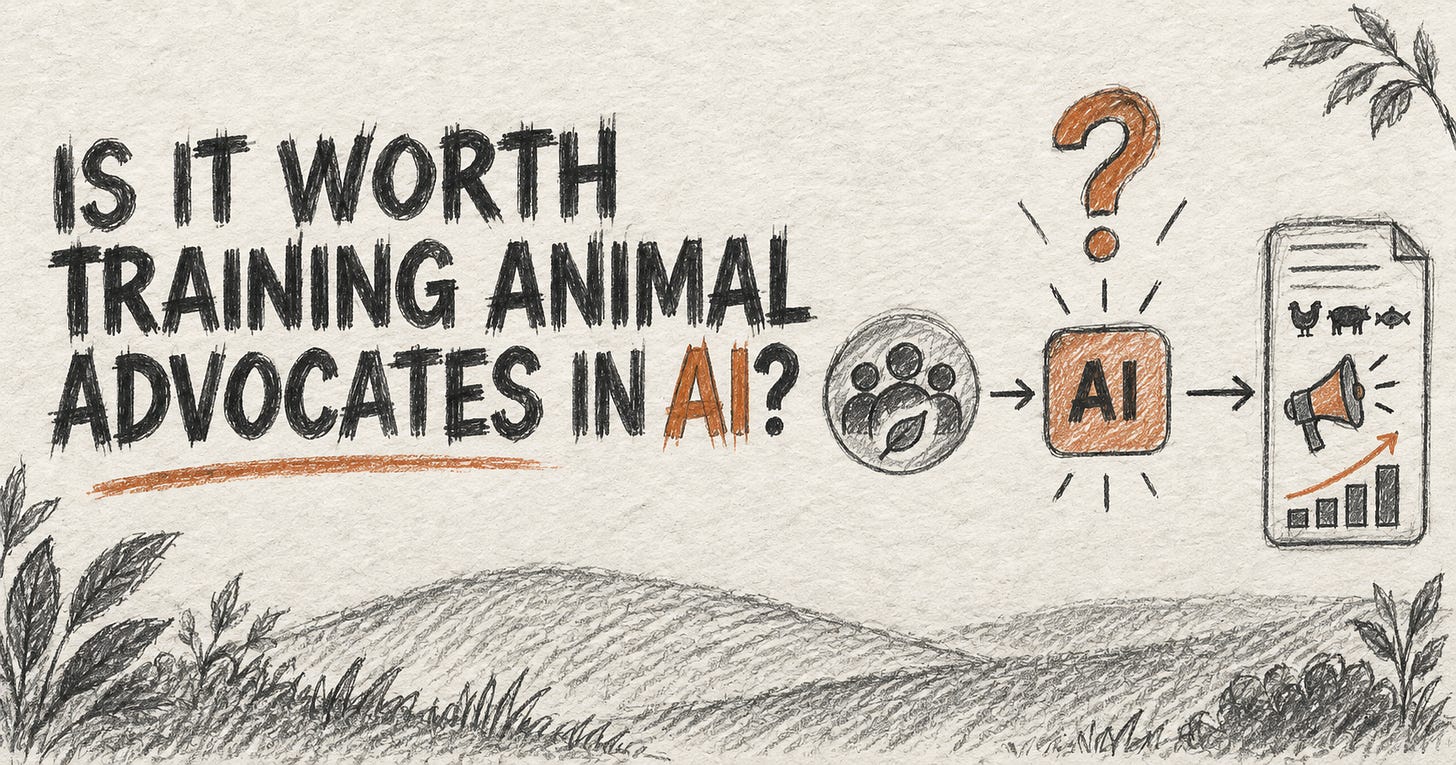
I’ve heard several people argue that it is not particularly worthwhile to upskill existing organizations and advocates in AI. As one example:
I am generally bearish on upskilling people at existing orgs. But there are many other approaches I think we should pursue:
Seeing if we can outcompete existing orgs with new orgs that use AI
A Palantir-esque forward-deployed team that can attach to existing orgs and build custom things for them
Using AI-enabled message testing
I haven’t seen anything promising yet on these.
– Itsi Weinstock, The State of the AIxAnimals Field (Apr 29, 2026)
Although Itsi doesn’t detail his reasons why he’s bearish on upskilling people at existing orgs, the arguments that I’ve heard from others typically hinge on three assumptions:
First, advocates may never use AI especially well, so the gains will be marginal at best.
Second, organizations will probably adopt AI on their own eventually, so purposeful upskilling efforts may accelerate them by only a few months.
Third, AI is changing so quickly that many current strategies may become less relevant; particularly if we reach AGI and ASI, we may need an entirely new set of strategies rather than investing heavily in existing ones.
I have some sympathy for these arguments and think there’s some truth here, but I think they miss several important considerations.
Plus, given how relatively cheap it is to upskill existing animal advocates in AI, I think that we would do ourselves a disservice by discounting it over the next 12–24 months especially.
Let’s go through each claim.
Claim #1—Why the gains from AI upskilling may be way more than marginal
First, consider the idea that advocates are difficult to upskill and will improve only marginally.
Even late last year, I would have agreed more with Itsi’s above recommendation that “A Palantir-esque forward-deployed team that can attach to existing orgs and build custom things for them” was probably needed for every organization that we cared about using AI effectively. ChatGPT was powerful, but to integrate it into any real software system or workflow required deep technical expertise. AI was still very useful for many things, but you really unlocked its power if you knew how to code.
I think this is less true as AI has grown more capable and as agentic coworkers such as Claude Cowork and ChatGPT Work bring AI’s power into the hands of more people, more easily.
These days, when I’m helping advocates with AI, the easiest and most powerful approach is often simply to ask a tool like Claude Cowork or ChatGPT Work to try the task:
Step 1—Open up ChatGPT Work.
Step 2—Paste in “can you do [X]?”
Much of the time, that is truly enough for the tool to solve all or a large part of a task or project. Current frontier models like Fable 5.1 and Astra/Sol are capable of accomplishing things that might be hard for many people to believe, if you just open the right tool and ask.
As the models keep improving and these AI coworker tools (Cowork/Work) keep making functionality more accessible to nontechnical users, it will take less technical knowledge and ability to leverage the power of AI.
That’s why if I could snap my fingers and give every advocate in the movement one AI capability right now, it would be access to something like ChatGPT Work or Claude Cowork, connected to the tools and information they use (Google Drive, Gmail, Asana, Salesforce, QuickBooks, etc.), and the ability to apply these tools to their existing work, including knowing how to use things like skills and scheduled tasks. With just that combination, most staff can extract a huge amount of value from AI.
An important note—In order to take maximal advantage of AI, organizations need to make these AI tools available to their staff and let staff connect the tools to the software that they frequently use. A tool like Claude Cowork without connections to commonly used applications is quite a bit less useful, since one of the primary benefits of these tools is the ability to work across tools to accomplish real tasks and projects like a human would.
Aside—Upskilling means more than just access to information
By “upskilling,” I want to emphasize that I do not mainly mean simply giving people more information about AI.
Information about how to use AI abounds online, and yet I regularly meet animal advocates who still haven’t learned how to use tools like ChatGPT or Claude, or their more agentic versions like Cowork or Work. So when I say that I think upskilling existing advocates in AI is impactful, I predominantly mean doing whatever is needed to help advocates actually use capable AI tools to get their work done and to do new work.
This may mean answering questions about job transitions or ethical concerns, or having hands-on sessions where you work side-by-side with advocates through the beginning phases of using agentic AI coworkers. It could mean talking about an organization’s approach to data privacy.
Importantly, it could mean helping them learn that AI itself can help you learn to use AI—showing them that a question like “can I connect my AI tool to Salesforce?” is a question that AI itself is perfectly well-suited to answer.
(As mentioned earlier, one of the most powerful habits anyone can develop these days is just regularly asking AI: “Can you help me do [X]? How?”)
Gains from AI can be marginal, multiplicative, or breakthrough
Advocates who use AI effectively can get different types of improvements in their work, depending on the work and how much they’re able to expand their work as AI gets more powerful.
Gains may look like marginal percentage-based gains (“I did [X] task in 20% less time”), or multipliers on existing work (“I can do 20x more of [X] task than previously”), or sometimes net-new projects that previously required multiple people (“I can now do the entire [X] project by myself”) or that wouldn’t have been possible at all (“I can now do [X] which previously would have been impossible”).
I have personally seen and experienced all of these types of uplift.
Some quick examples:
A data-analysis and PowerPoint task that I estimate would have taken roughly two days required approximately ten minutes of human working time through Claude. The output was reviewed for accuracy and used in a real presentation.
A research project that might previously have taken one or more months required a few hours of human work generating deep-research reports with ChatGPT, Claude, and Gemini, then integrating them through ChatGPT Work. I know of several cases like this, some complete and some still in progress.
I have also repeatedly seen multi-hour software bug searches and repairs become a single prompt to Codex. A few months ago, a bug fix might have been a couple of prompts—these days, it’s usually a single prompt of “find and fix [X]”. A couple years ago, these types of bugs may have consumed substantial percentages of my week.
Creating a one-off website for an idea (such as this) can be a small number of prompts to one of the more powerful models like Fable or Sol.
The rise of the high-agency generalist
And as using AI to accomplish tasks and projects becomes easier, it will become less valuable to know how to do narrow specific tasks (because AI can just do them now) and more valuable to be the type of person who can pull together resources, think critically, and proactively pursue goals. If AI can handle much of the website-building or data-analysis or campaign target research from a few prompts, then a single AI-empowered person who knows which campaign to run in the first place becomes even more valuable.
(Note: I say this as someone who for years invested in narrow skills that AI can now do, such as programming and data analysis. One dynamic, though, is that people with these narrow skills can often be the best people to use AI for those types of tasks! At least for now.)
I think that as time goes on, we’ll need fewer people whose primary contribution is narrow specific tasks that AI is very good at, and I think we’ll need way more people who can think strategically and critically about impact, set a goal, and then take action toward that goal using whatever resources they have at their disposal.
And they will have a lot of resources at their disposal, in the form of highly capable AI. AI suddenly gives high-agency people far more resources to draw upon to accomplish the goals they set. By leaning into this now, we can help advocates learn the requisite skills and start thinking of themselves more as general operators rather than narrow specialists. These abilities will pay off more and more in the coming years.
Upskilling advocates in AI now may also lay the groundwork for people to transition into different roles over time. If somebody working at an organization learns how to use AI effectively (and perhaps learns a bit about broader AI impacts on society as well), they may notice high-impact opportunities they would not previously have considered or been able to pursue. Even incremental upskilling of nonprofit staff can therefore increase the chance that the movement is able to take advantage of future opportunities by creating a broadly trained and knowledgeable base.
The impact of upskilling existing advocates
The possible movement-wide impact of AI upskilling is large, although of course impossible to perfectly know.
Just to put some numbers on things, let’s say that it’s not uncommon for AI to help someone do 10% more in a week than they could previously, or let’s say an extra 4 hours’ worth of work in the same amount of time. If the farmed animal advocacy space has about $300 million to spend per year, and if AI upskilling improved the effective use of 10% of that resource base by 10%, that would amount to a 1% gross improvement overall, or roughly $3 million per year.
And if AI helped us improve the output of our overall funding base by 10%, that could be equivalent to an extra $30 million per year.
And speaking for myself, the impact of effective AI usage has been way beyond a 10% gain in my overall output. Not only has my individual output increased, but I have been more capable of adapting to each successive wave of improved AI tools as well.
Imagine a whole movement of individuals who get marginal gains now, and compounding benefits over the coming months and years.
Claim #2—Wouldn’t adoption happen anyway?
The second claim is that AI adoption would happen anyway and perhaps only a few months later, so it’s not worth proactively investing in it now.
There are a few considerations to discuss here.
First—A meaningful AI adoption gap still exists
In a March 2026 Open Paws survey of ~200 advocates representing ~140 organizations, about 50% of respondents used AI monthly or less. At an organization that I recently met with, ~75% of staff use AI occasionally or never.
This shows that adoption is still facing barriers and why upskilling needs to mean more than simply “provide more information”—it needs to target the true barriers behind the lack of value-add adoption.
This adoption gap could point towards a few causal explanations:
AI isn’t useful, and therefore isn’t being adopted.
It’s hard to upskill advocates, which maybe means it’s less tractable and less worth investing in.
The level of investment in AI upskilling for advocates globally has not yet matched the current total need.
#1 was more true for less-technical people 12 months ago (although it was still useful, just less so); it’s less true now. This could point to a lag in people’s perceptions vs. reality.
#2 is plausible, and may be true for some individuals or organizations.
However I continue to think that #3 is the primary reason—that our level of investment in upskilling efforts has not yet matched the total need.
I was one of the educators for the initial Amplify for Animals AI training program last fall (a program which is continuing this year under Vegan Hacktivists), which to my knowledge was the largest AI upskilling effort the movement has had to date. In my estimation, this program was a large success, with 1,100+ individuals registered and hundreds attending live each week and reporting significant gains in AI competence and confidence by the end of the course.
We are continuing that program this year, in addition to the work that the AI Services team at Vegan Hacktivists is doing. There are a small number of other AI educators in the space, and what appear to be a minority of organizations that are creating dedicated time and space for AI upskilling internally (although this fraction seems to be growing).
Given that newer AI tools and models have represented something of a step change in capabilities that are accessible to less-technical staff, this year potentially marks a bit of a new phase for upskilling, where potential gains are much larger than in the past.
All of this points to the idea that adoption may happen anyway given enough time, but that there are very clear steps we can take now to unblock it or accelerate it, and that it doesn’t appear to be happening on its own in a widespread fashion—at least not as quickly as we’d like it.
Second—A few months can be an extremely long time during a period of rapid AI progress
What if we say that adoption might not happen immediately, but that it might just be delayed by a few months or years?
Here, we need to think about (1) productivity differences over time and (2) ability to adapt to a rapidly changing world.
The best time to start was 12 months ago—the second best time to start is now
For an advocate who started using AI effectively 12 months ago, that advocate has plausibly done much more work and had much more of an impact compared to an advocate who has not started using AI yet, especially if our advocate who started 12 months ago also picked up something like Claude Cowork or ChatGPT Work this year.
If we can meaningfully accelerate adoption of powerful AI tools by 6 or 12 months, we give the animal advocacy space substantially more capability during that period—and then we start the next period at a higher baseline and with greater levels of capabilities. Early upskilling lays the groundwork for faster adoption of future tools, allowing the knowledge gained now to compound further.
Our hypothetical advocate above who started using AI 12 months ago not only got more work done over the last year, but they are also more capable of adapting to the current wave of AI tools than someone who is just starting to use AI. This is subtle, but might be one of the most important dynamics of early AI adoption.
Over the next year, better interfaces and more intelligent models seem poised to continue reducing the level of technical skill required to leverage AI effectively. Tools like ChatGPT Work and Claude Cowork can already write code for users to help them accomplish all kinds of tasks that previously would have required someone with coding expertise. In 12 months, it may be the case that specialized technical knowledge is even less necessary. Next year, you may be able to simply open up your AI tool of choice, give it any kind of open-ended knowledge work task, and have it handle all the technical complexity for you—coding, software connections, website development, setting up automations, and so on. I’m not completely sure of this, but this seems to be the direction that things are going.
If we don’t proactively assist with advocate upskilling, then the natural pace of adoption could be much slower or potentially even stall. For example, I’ve worked with many organizations whose internal AI discussions were stalled by various kinds of fears and unease—without someone to help organizations work through those conversations, it’s plausible that the fear-based approach to AI becomes more entrenched and some organizations fall further and further behind.
I’m closely connected to many of the people doing AI upskilling and enablement across the movement, and I can fairly confidently say that without this small group of people investing time and energy to assist organizations, many advocates and organizations would not be upskilling at all or would be doing so much more slowly. This points to a need for proactive investment right now to help organizations navigate the current situation.
Claim #3—What if our strategies need to change in a post-AGI world?
If our work is going to need to completely change in a post-AGI world, then trying to squeeze marginal gains out of existing approaches seems to not be worth very much.
I think this view is probably correct to some extent, although gains in our current work are still worth having compared to no gains. But yes, many of our assumptions and strategies may need to be reconsidered from the ground up in a post-AGI world. There are several reasons why investing in AI upskilling efforts for existing animal advocates now is still a smart bet, though, especially in situations of extreme uncertainty, even if much of our work may need to change.
AI-empowered advocates will navigate the post-AGI transition better
If we invest in AI upskilling now, existing advocates will be better prepared to navigate transitions as they arise and potentially move into new roles, maintaining their existing advocacy knowledge and relational networks. New people from outside the animal advocacy space would need to develop domain-specific knowledge and relational networks, which would take time (especially to build networks of trusted relationships).
We should also find new people from outside our existing pool of advocates as needed, of course, but we will give ourselves the greatest chance of success if our existing base of people also has the requisite knowledge needed to navigate this transition and watch for new opportunities. If we take existing advocates and upskill them in AI, we empower our current base of people power to better identify and act on new opportunities.
If we need to pivot strategies in the future (which seems likely), our current base will be more prepared and capable because its members have already developed AI skills. And we can still always bring in new people as needed.
The animal advocacy space will need different skill sets because of AI, but AI also empowers individuals to rapidly gain abilities
As AI tools become more powerful and easier to use, some advocate skills become more valuable and some become less.
For example, I expect access to powerful AI capabilities to improve quickly for nontechnical workers, since tools like Claude Cowork and ChatGPT Work have been a great success so far and AI companies have strong incentives to make their models more usable by a much wider group of people.
In general, this would seem to imply that we need less expertise in anything that AI can easily do, and what we will need more of is people with high agency who can pull together resources across domains to accomplish goals.
This is potentially a very different type of skillset that we would need to hire and train for compared to how we’re currently hiring and training. Rather than hiring for narrow skills like data analysis in Python, or frontend web development in React, or copyediting, we should probably start thinking about roles that operate at a higher level—we should probably start hiring for people who take ownership of full projects and are willing to flex across domains as needed to get those projects done. These kinds of skills will become more and more valuable as AI gets more powerful.
And notably, to capture these gains I do not think we will need every animal advocate to learn how to code or to become a junior software engineer—this type of technical knowledge is still quite valuable as of September 2026, but my current hunch is that it may become less important as AI coworker tools handle more of the technical complexity for us. (I say this as someone who is proud of my hard-earned technical knowledge.)
The type of advocate we will need
All else being equal, we will want to either find or train people with these types of qualities as AI becomes more powerful:
High agency: Able to set goals and carry projects through to completion.
Strategic thinker: Thinks about which goals we should be setting in the first place.
Rapid learner: Can quickly pick up new skills or domains and connect disparate domains together in order to accomplish goals.
Has trusted relationships: Able to build and utilize relationships to achieve goals.
Has commitment: Stays in the space long enough to accomplish important things, and is dedicated to setting us up for future success as well.
Able to use AI well: Uses AI to accomplish many specifics of goals and projects, to learn, and generally to operate across all aspects needed. As AI becomes more capable, the advocate becomes more capable.
So the question of this article at its core is, is it easier to upskill existing advocates to have these qualities or to find new people with these qualities?
We may have exactly who we need
Surprisingly, one plausible future is that existing advocates—with their networks and knowledge of animal advocacy—are exactly the people we will want to have in the future, provided that they can use AI well.
This is because it takes a lot of time to build up networks of trusted relationships and to build up nuanced knowledge about the advocacy space. Existing advocates already have the networks of trusted relationships and the in-movement context about advocacy issues. If they can use AI well, then that could make them more valuable than entirely new recruits who possess stronger AI skills but lack animal advocacy context and relationships.
Of course, I’m inherently suspicious of the answer that “who we have now is exactly who we’ll need in the future”, so I expect this to not be true to some extent. Sometimes, a new high-agency generalist who uses AI extremely well may be the better choice than an existing advocate who has less of one of those key skills. Perhaps over the last decade we’ve been training advocates too much in narrow skillsets and too little in things like taking ownership, thinking critically across domains, and pulling together resources to complete full projects. If that’s the case, and if it’s difficult for existing advocates to gain those skillsets, then we may need a larger percentage of net-new people as time goes on.
The underlying question here going forward will be whether it is easier to help an existing advocate develop high agency, rapid learning ability, and AI competency, or to find someone new who has those skills and give them the specific domain expertise and relationships they need.
I think we give ourselves the best shot by assuming that current advocates can evolve their skill sets as needed and helping them upskill accordingly. If that assumption turns out to be wrong, we can always bring in more new people who have the needed skills.
But if we assume that our current people are not capable of evolving and growing with AI’s capabilities, that to me seems like the much riskier and more wasteful assumption.
What should the animal advocacy space do right now?
This will remain a fluid situation, but I think a strategic recommendation for right now is something like the following:
Every animal-advocacy organization should invest meaningful time and energy in AI upskilling over the next twelve months, especially in getting staff members skilled in using “AI coworker” tools like ChatGPT Work or Claude Cowork (and for maximal benefit, staff should be able to connect these tools to the software they use most frequently). “Meaningful time and energy” doesn’t have to mean significant financial investment. Standard AI tools like ChatGPT and Claude subscriptions are relatively cheap especially with nonprofit discounts, comparable to any other software subscription for staff. If used effectively, they are well worth the cost. For most organizations, the primary blocker will be deciding which AI tool to use, which software connections they are willing to allow, and then dedicating initial time to learning and testing AI on various workflows. (And for the orgs who have already invested significant time and energy into your staff—thank you!)
Related: There is a new 8-week AI Foundations course for animal advocates starting in October that focuses on AI coworker tools: https://veganhacktivists.org/amplify.
Funders should continue investing in AI enablement efforts for organizations, especially efforts that lead to broad staff upskilling in AI coworker tools, especially over the next ~12 months. The next 12 months are especially important because (a) AI tools are still nontrivial to extract significant value out of, and (b) investing now will mean that advocates are able to capitalize on future AI advancements more easily. (And for the funders who have already invested significant funding into these efforts—thank you!)
Advocates and organizations should rapidly develop the following capabilities where possible: high agency; ability to learn quickly; ability to pull together resources and connect individuals to accomplish goals; ability to use AI effectively for more and more tasks over time. These are the abilities that will become even more important as AI gets more powerful.
When hiring, start giving much greater weight to the skills in #3.
Over the next 6–12 months, regularly reassess the situation as it affects the above.
Conclusion
As time goes on, our strategies will need to shift, and the skills that advocates have will need to evolve.
We may need new organizations, new strategies, and new people. This is almost assuredly the case, to some extent.
But the best way to prepare for that future is to also upskill our existing base of organizations and advocates.
By upskilling existing advocates in AI now, we (1) get gains in existing work, (2) help those advocates more quickly take advantage of future more powerful AI tools, and (3) prepare existing advocates to evolve into different roles and strategies in the future as needed by a post-AGI world.
And as AI gets more powerful, many specific skills will be less valuable (i.e. the ones that AI can easily do) and there are general skills that will become much more valuable: being high agency, taking ownership of full projects and goals, knowing which goals to set in the first place, and pulling together people and resources to accomplish those goals.
The world is changing rapidly. We give ourselves the best shot of evolving with it if we empower our existing advocates now with the AI skills they need.
Also published on Substack, where you can get new essays by email.